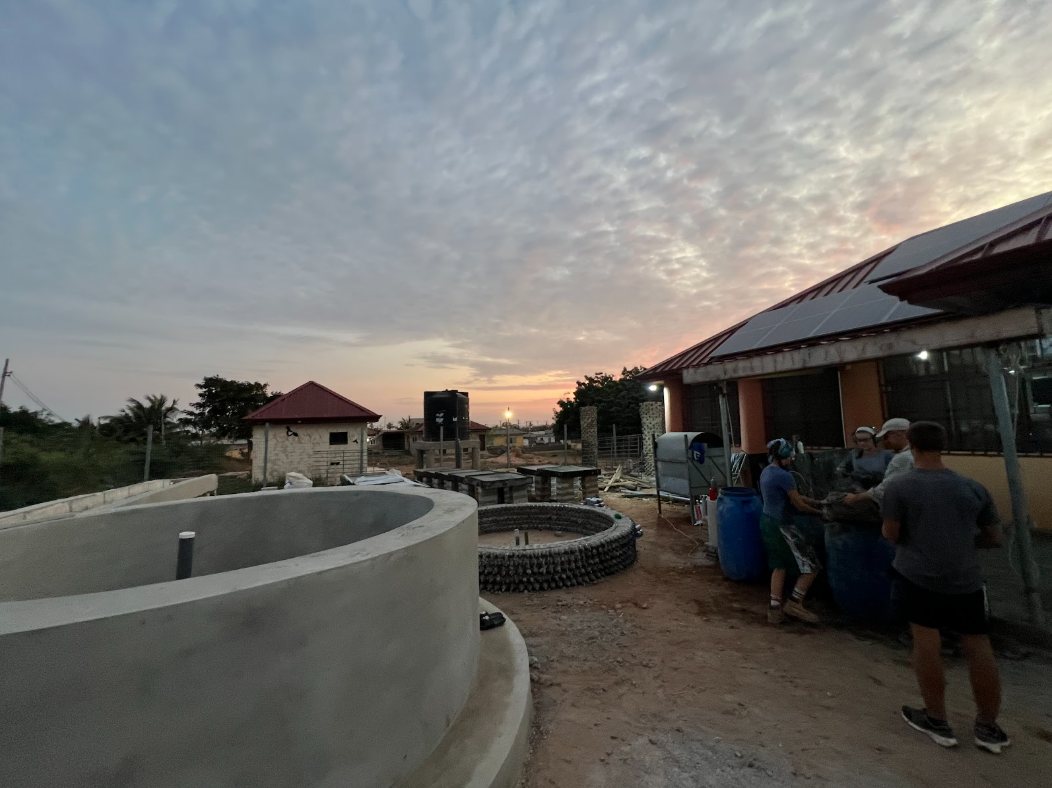
Working on the aquaponics system here is perhaps the hardest I have ever worked physically, but the most fulfilling work too. Designing plans with friends and experts, we are finally able to put them into action and see plant trays and fish tanks popping up before our eyes. Next year, when I return in November, the atelier proposed by some of my friends for girls from the village to use to sew reusable and sustainable sanitary products will be nearing completion, the fish tanks will already be almost ready for the new African Catfish, and the first plant tray will have towering banana plants thriving in it alongside basil and lettuce. Then, the next step will be to survey local food merchants and restaurants, finding out which plants they need, so that we can formulate a business plan. We have studied and trialled aquaponics systems at home, learning about how the ammonia found in fish waste is filtered out and converted into nitrates by bacteria to provide fertiliser for plants, which in turn clean the water for the fish. Here in Ghana, we are experimenting with “aircrete”- concrete mixed with soap to create air bubbles, resulting in a lighter, more sustainable material that we can use for the plant trays. Today, we finally finished screwing together the wooden moulds and lining them with fibreglass, and we have poured our first trial slab. Tomorrow, we will return to the site and find that our mixture was not quite right, but the second trial will work out perfectly.
Although we have temporarily taken over with our glue and gloves and power tools, tracking red Ghanaian sand across the floors inside, the San Kofa centre is, first and foremost, a learning centre. In the second room, the library is filled with books and games for children and adults of all ages – during my water breaks, I write down the names of some books I would like to read. I have learnt my lesson the hard way to not forget my suncream, and I need to rummage through my backpack filled with my notebook and pen, my raincoat, my cereal bars, and, if I’m lucky, a small tinfoil-wrapped parcel of Jane’s banana pancakes to find it. After we have tidied up our bags and swept away the cement dust, the San Kofa centre will once again become a haven for children to come to after school- to read in the library or in the summer hut outside, play with their friends and learn about aquaponics. The centre itself is also made, ingeniously, with PET bottle bricks – layer upon layer of PET bottles packed with sand and filled in with cement, which is what we are using to build the fish tanks, too. Just outside, another group of students is using sticks to painstakingly fill even more recycled bottles.
As the sun sets on our day at the San Kofa Centre, we prepare to walk back through the village. Our teachers told us that greeting people as we walk may be the biggest culture shock for us. We pass children, motorcyclists and street vendors, each of whom extends a kind smile and greeting. When we first arrived in the village, we were even taken to meet the chiefs of the village so that they could acknowledge our stay. My shorts and t-shirt are now almost completely covered in a mixture of concrete, soap, water and red mud. My hair has been braided into several small braids that I know will take some effort to detangle by children from the school next door to the San Kofa center who decided to visit and befriend us newcomers during their lunch break. I have managed to get cement dust in my hair from wearing a make-shift hat folded out of an empty bag of cement powder. I am thinking about whether I have enough room in my luggage to bring my “concrete hat” home. My legs are tired from carrying buckets of water and from crouching to wrap string around PET bottle bricks, laying ring upon ring to create the third and final fish tank, and I know I will sleep well tonight.
Leave a Reply