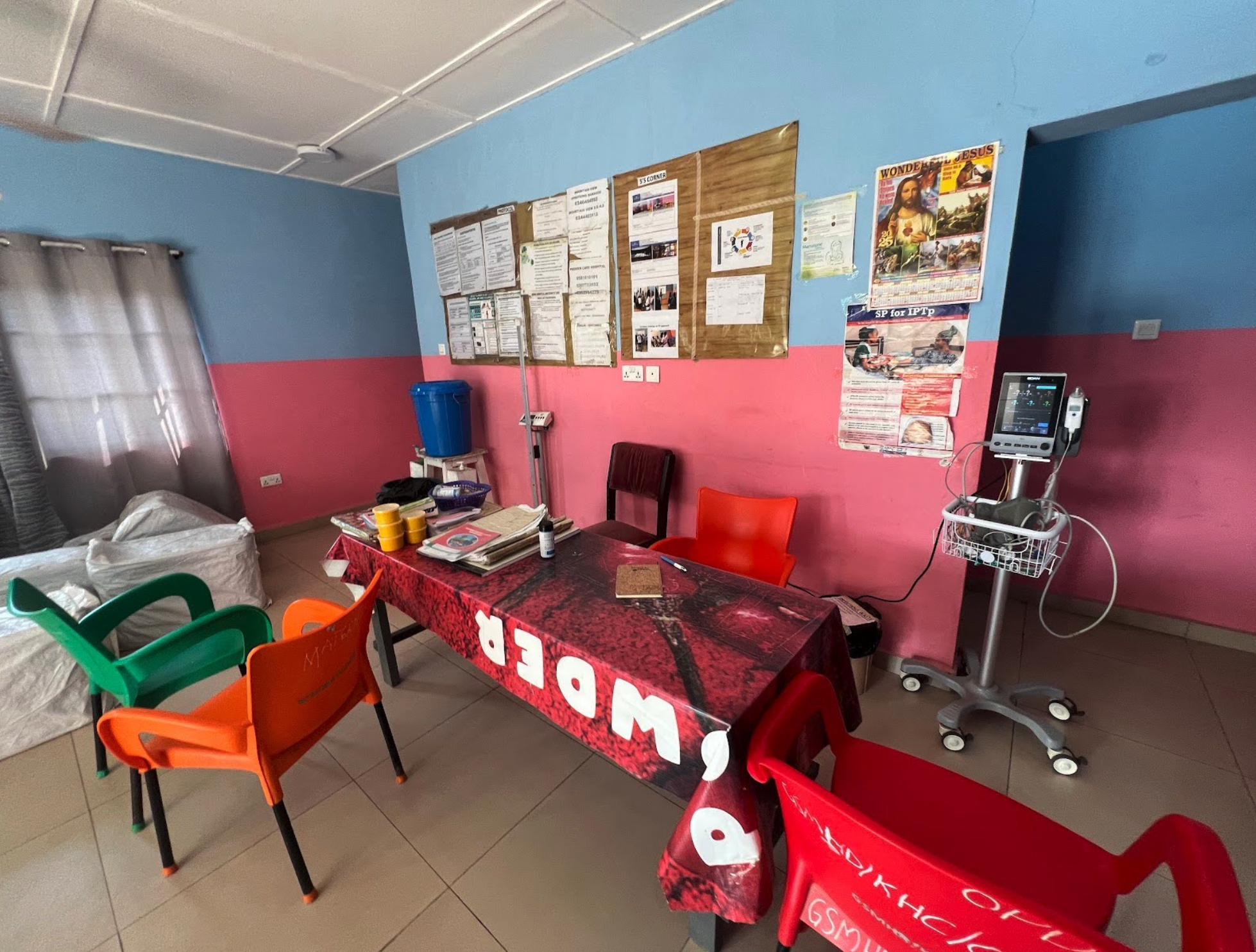
The reception desk in the maternity ward is essentially my base of operations on the days I work in the clinic. I am never sat here with nothing to do for more than five minutes at a time – at any moment, a midwife might call from the consultation room behind, calling me to come and be taught how a particular examination should be performed, or to bring a file, or to copy down a patient’s information into ‘The Book’. The book itself is falling apart at the seams, spilling over with names, professions, dates of birth – rigid numbers that tell the tales of the beginnings of hundreds of families. Or, later in my trip, I may be called to perform an examination I have been taught myself, with a midwife watching and correcting me: reminding me to press firmly during a palpation so that I can properly measure the baby’s height and showing me where to put the Doppler ultrasound machine to hear the baby’s heartbeat. Or, midwives may hurriedly begin walking down the corridor to the small delivery room at the end – a birth, or some other procedure, where I can watch and pass equipment from the sidelines, quietly trying to memorise each moment.
On the table sit pots of shea butter for patients to take for the upcoming Harmattan season, when dry winds will cause locals to take refuge in woolly jumpers, despite temperatures only dropping to a balmy (compared to what I’m used to) average of 20°C. Next to these sits ‘the book’, a number of pamphlets, including some from Colgate, explaining the necessity of tooth-brushing, and malaria prevention medication (which is to be given out to expectant mothers). Malaria is still endemic in Ghana, although the nurses and midwives I speak to have hope that a new vaccine already being used in Cape Coast will soon eradicate the disease from coastal Ghana.
The fan overhead is loud, which is not something I realise until the buzzing abruptly stops, and the fan slows to a halt, leaving only thick, warm air: yet another power cut. While the main clinic has a generator, the maternity ward has been moved to a new building, which has yet to be connected. At one point, I even used an iPhone torch during a delivery to give light for the midwives.
To the immediate right of this desk is a small waiting area, which is never empty. Mothers, mothers-to-be, friends, relatives, children, and babies strapped to their mothers’ backs fill the metal seats in equal parts anticipation, fatigue and tranquillity. Once a week on a Friday, this waiting room will be even fuller than normal, with at least a dozen women arriving to attend “pregnancy school” where midwives teach a year-round curriculum of nutrition, infant care, early education skills, hygiene and more. Different languages fill the air – mostly English, Twi and Ga: I can hear small phrases that I’m starting to pick up on. All of the midwives can speak most, if not all, of the languages here, and I’m informed that I should try to be able to as well. I think that may take a while. But still, while I’m taking a patient’s blood pressure, I recognise some phrases in the conversation to my right: “We didi?” (Have you eaten?) “Undidiye” (I haven’t eaten). Later, during a quiet moment, I’ll ask another midwife to teach me some more, and she’ll very kindly write down some words in my notebook, some more pearls that I’ll sift out of the conversations swirling around me tomorrow.
Leave a Reply